

Assignment samples
This section features a collection of original assignments I have designed and developed to support learning in Graphic Design and UX/UI courses. Each project reflects my commitment to clear structure, real-world relevance, and creative exploration. These assignments are crafted to challenge students to think critically, engage deeply with the design process, and build skills that translate beyond the classroom.
Design Research Methods
PROJECT 2:
PRIMARY RESEARCH
Focused on first-hand user insights, this assignment introduces students to qualitative research methods including interviews, contextual inquiry, netnography, and focus groups. Students learn to document, synthesize, and reflect on real user behaviors to guide future design strategy.
PROJECT 4:
STRATEGY
PROJECT 5:
DESIGN SOLUTIONS
Students turn insights into action by brainstorming, mapping features, and testing assumptions through surveys. Using affinity diagrams, dot voting, and effort-impact matrices, they define an MVP and use data visualization to back strategic design choices.
This assignment transitions students from idea to execution. Working in teams, they build lo-fi and mid-fi wireframes, develop user flows, conduct usability testing, and prototype their final design in Figma. Reflection and A/B testing complete the UX process.
ux research in-class exercises
double diamond framework
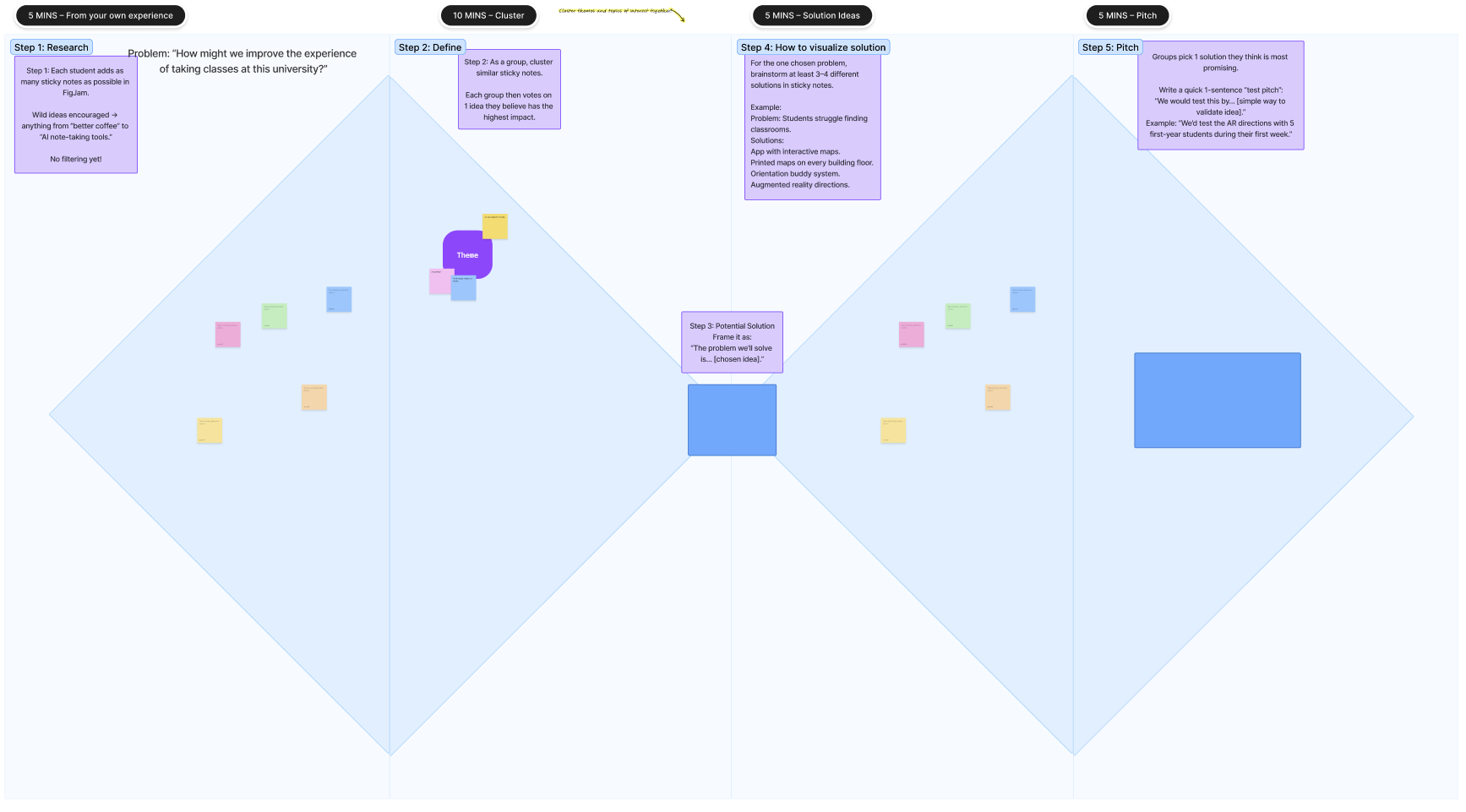
This hands-on team exercise walks students through the Double Diamond process in a fast-paced, collaborative format. Starting from individual reflections on a shared problem, teams move through sticky note clustering, idea definition, solution sketching, and quick pitching. It's designed to reinforce divergent and convergent thinking, and help students practice how to define problems clearly before jumping into solutions.
competitive
analysis
Persona, empathy map
and Journey map
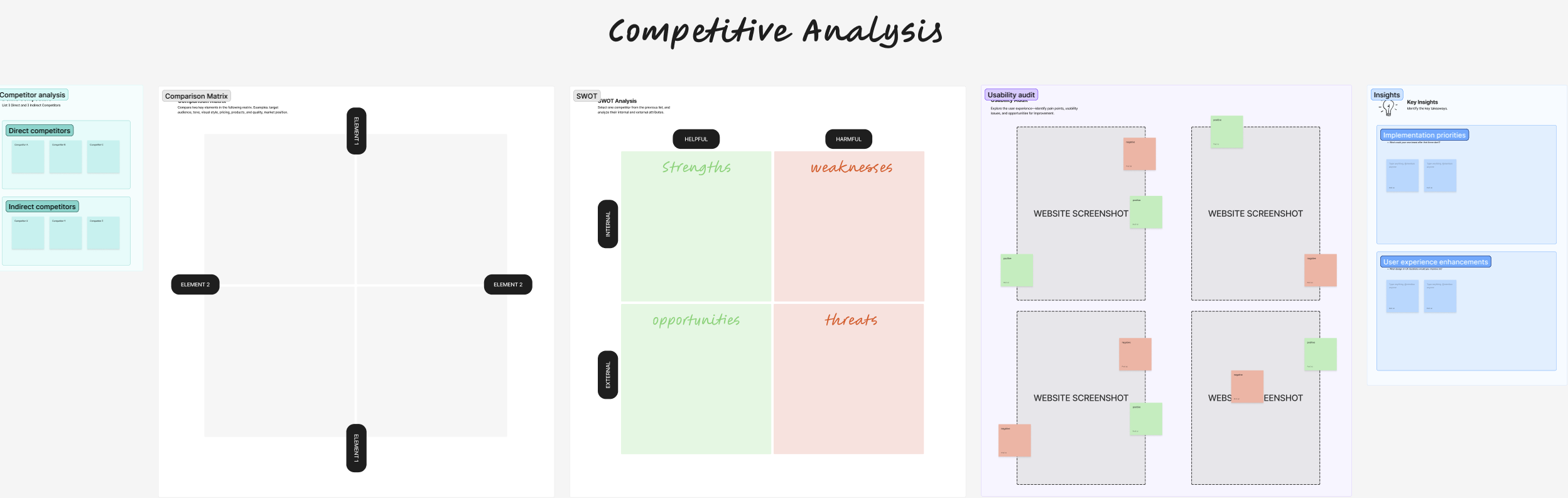
This structured FigJam board guides students through a full competitive review of digital products. With templates for identifying direct and indirect competitors, a SWOT matrix, and side-by-side usability audits, students practice critical analysis, pattern spotting, and synthesizing insights into actionable UX opportunities. It's perfect for early-stage research or stakeholder presentations.
This board combines three foundational UX frameworks: personas, empathy maps, and journey maps—into one cohesive exercise. Students use the guided layout to build fictional users grounded in real data, explore their thoughts and behaviors, and visualize emotional highs and lows across a user journey. The summary section prompts critical reflection and helps teams identify patterns and opportunities.
interactive Design Concepts
PROJECT 1:
scrollable website
A beginner-friendly UX project where students design a three-page scrolling website informed by user research. Through interviews, surveys, and personas, they develop digital solutions supported by clear visual systems, empathy maps, and user flows. Final deliverables include a fully designed hi-fi prototype with rationale.
PROJECT 2:
mobile app
PROJECT 3:
website redesign
This intermediate UX project challenges students to design a functional mobile app using the Double Diamond framework. Students conduct surveys, contextual inquiries, and map user needs into flows and features. Deliverables include mid- and high-fidelity prototypes, custom iconography, and annotated design rationale.
An advanced project where students select a real DFW business with usability issues and conduct a full UX overhaul. This includes heuristic evaluations, contextual inquiries, card sorting, feature ideation, and high-fidelity redesigns ready for developer handoff.
ui dESIGN IN-cLASS eXERCISES
BRAINSTORMING
AND pRIORITIZATION
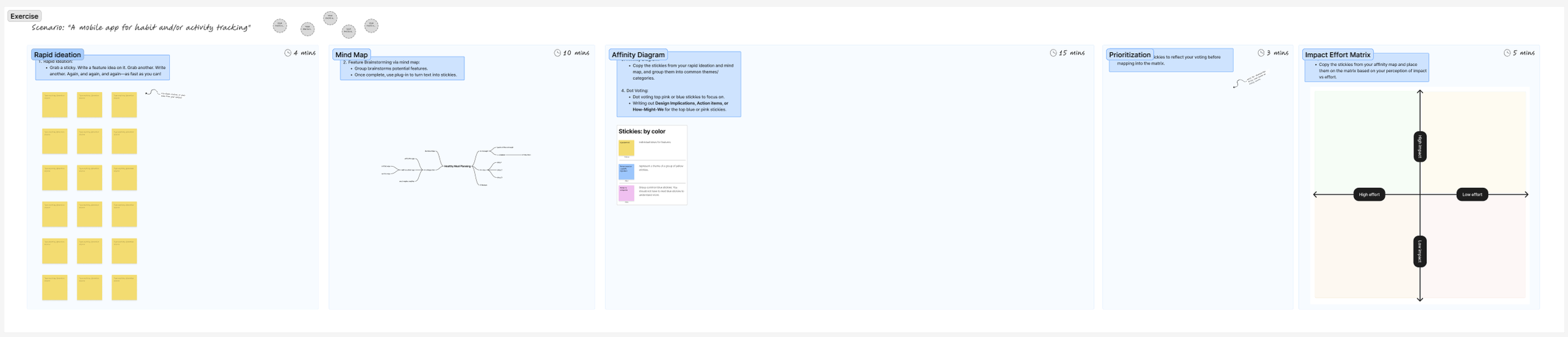
This team-based FigJam exercise walks students through a full ideation workflow, from wild brainstorming to a focused, MVP-ready feature list. By combining rapid ideation, structured mind mapping, thematic affinity clustering, dot voting, and impact/effort analysis, students learn how to turn a broad challenge into a strategic, research-informed plan of action. The template includes prompts, examples, and space for collaborative synthesis; ideal for mid-semester project planning.

THE (mESSY) jUICE BAR
qUICK RE-DESIGN
ui dESIGN eTHICS & COMMUNICATION
In this exercise, students analyze and redesign a poorly structured webpage using Gestalt principles. By focusing on proximity, similarity, continuity, and other core visual grouping strategies, students practice improving usability through layout, not just aesthetics. The goal is to build visual clarity and intuitive structure by applying at least five Gestalt principles to a real interface challenge. Annotations explain design decisions, encouraging reflective thinking on visual perception and user experience.
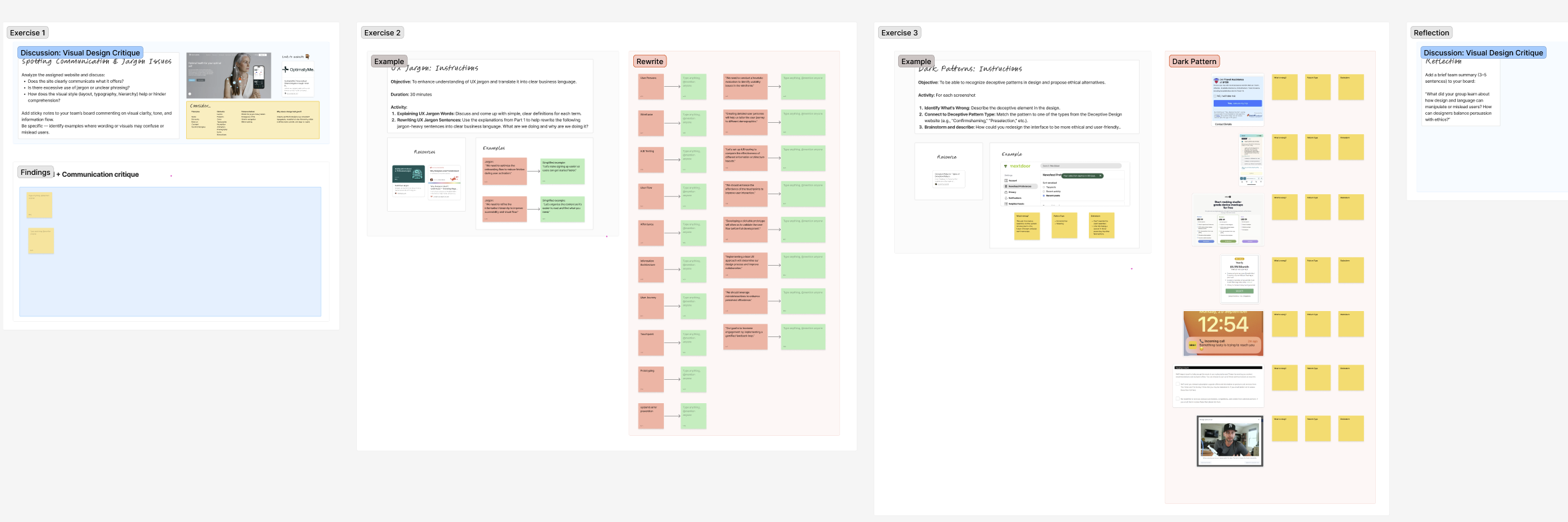
This group exercise focuses on the intersection of language, design, and ethics in user experience. Students work in teams to analyze real websites for communication flaws, rewrite jargon into plain language, and identify deceptive UX patterns. It builds awareness of how tone, hierarchy, and word choice impact user trust, accessibility, and overall clarity. This session sparks conversation around ethical design and encourages students to advocate for transparency and usability in their work.

I’ve developed a collection of custom Figma templates to support every stage of the design process in the classroom, from research and synthesis to prototyping and critique. These resources are used actively in my classroom to help students stay organized, think critically, and produce professional-quality work.